AI Epistemology: Different LLMs, Better Security Decisions
Different LLMs can challenge the same security problem from different perspectives, exposing blind spots and improving the final decision. The future of cybersecurity will not just be AI-assisted — it will be collaboratively intelligent.
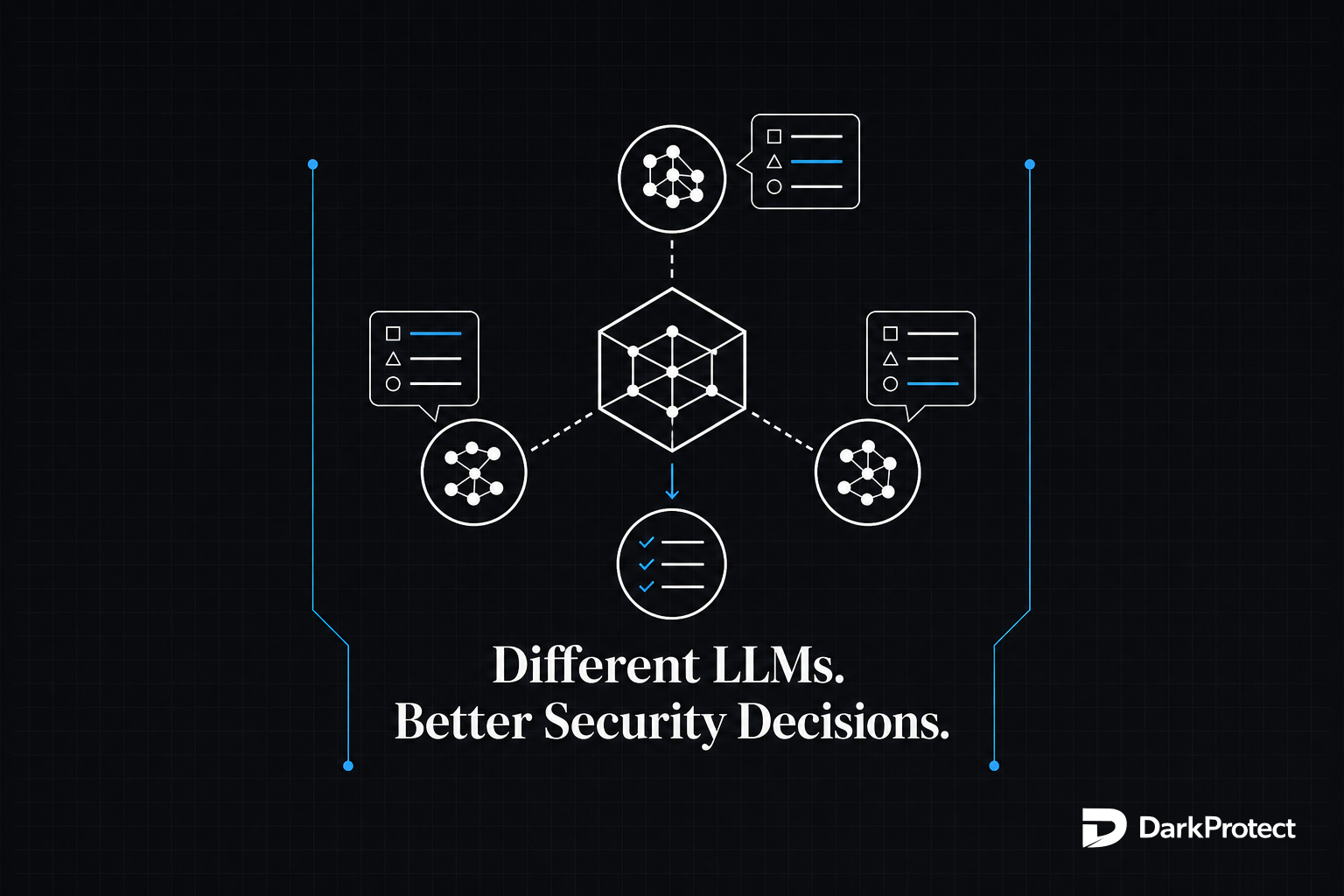
Imagine a security architecture review with three experienced architects.
The first says:
Risk acceptable.
The second disagrees:
The analysis assumes administrative access is properly segregated, but there is no evidence of that.
The third adds:
The control reduces authentication risk, but privilege escalation is still insufficiently addressed.
The result is not three opinions.
It is a better conclusion.
The architecture may be acceptable, but the assessment is incomplete. Administrative segregation must be evidenced, privilege escalation must be addressed, and the residual risk should be reassessed.
This is why teams create value.
Different people see different things. They challenge assumptions, identify blind spots and improve each other's conclusions.
It is the same with AI.
One LLM gives you one perspective
Most AI usage still looks like this:
Human → LLM → Answer
You ask a question. One model gives you a response.
It may be excellent.
But it is still one model, with its own strengths, reasoning patterns and blind spots.
Now ask several AIs, powered by different LLMs, to analyze the same problem.
One produces the first conclusion.
A second reviews it.
A third challenges both.
They all examine the same architecture, the same evidence, the same risks and the same business context.
But they do not necessarily interpret them in the same way.
One may notice an assumption another accepted.
Another may identify a risk the first underestimated.
Another may spot a contradiction or a missing piece of evidence.
Then the conclusions are combined.
The result is not more text.
It is a richer, stronger and more defensible conclusion.
Different LLMs are the point
Using several agents on top of the same model can help.
But it can also create an echo chamber.
Same model. Same blind spots. Same mistake repeated several times.
That is why model diversity matters.
Different LLMs can approach the same problem differently and, importantly, fail differently.
The objective is not to make them agree.
It is to make them challenge and improve each other.
Consensus is not the same thing as truth.
Why this matters in cybersecurity
Cybersecurity rarely gives us perfect information.
We assess incomplete architectures, estimate risks, interpret evidence, review controls and anticipate attackers.
In that environment, the first answer should rarely be the final answer.
A better process is:
Generate. Challenge. Reassess. Improve.
This is where AI epistemology becomes practical.
Not:
What did the AI answer?
But:
Why should we trust this conclusion?
What evidence supports it?
What assumptions were made?
What did another model see differently?
What remains uncertain?
That is much closer to how strong security teams already work.
Better does not mean free
This approach also has limits.
More models mean more cost, more latency and more orchestration.
Different models can still reinforce the same wrong assumption or converge on a false consensus.
So the objective is not to multiply agents.
It is to introduce meaningful model diversity, structured challenge and human oversight where the decision justifies it.
From idea to practice
This is also the direction we are exploring at DarkProtect and CSFaaS.
Not AI as a single oracle, but AI as part of a security reasoning process where different models can review, challenge and enrich the same assessment.
The foundation is already familiar: structured evidence, explicit assumptions, controls, risk context and traceable conclusions.
The next step is to let different intelligences reason over that same context and improve the result together.
The objective is not AI for the sake of AI.
It is better security decisions.
The future is not humans versus AI.
It is humans working with AI — and AIs working with other AIs.
For years, the industry has focused on one question:
Which model is the smartest?
The better question may now be:
What happens when different models start thinking together?
The next generation of security will not simply be AI-assisted.
It will be collaboratively intelligent — humans and multiple AIs, powered by different LLMs, challenging, complementing and strengthening each other.

Cyber Resilience Act (CRA): What Changes with ETSI’s 17 Draft Standards in 2026
The CRA enters its operational phase with 17 ETSI draft standards. DarkProtect analyses timelines, SBOMs, supply chain security and product…
Read article
OT Security Is Not Just IT Security with Different Devices
OT security is not simply IT security applied to different devices. When cyber risk reaches industrial environments, the consequences can affect…
Read article