OT Security Is Not Just IT Security with Different Devices
OT security is not simply IT security applied to different devices. When cyber risk reaches industrial environments, the consequences can affect production, infrastructure, safety and physical processes. This article explores what makes OT security different, the key challenges organizations face, and the main references to know, from NIST SP 800-82 and ISA/IEC 62443 to MITRE ATT&CK for ICS, CISA and NIS2.
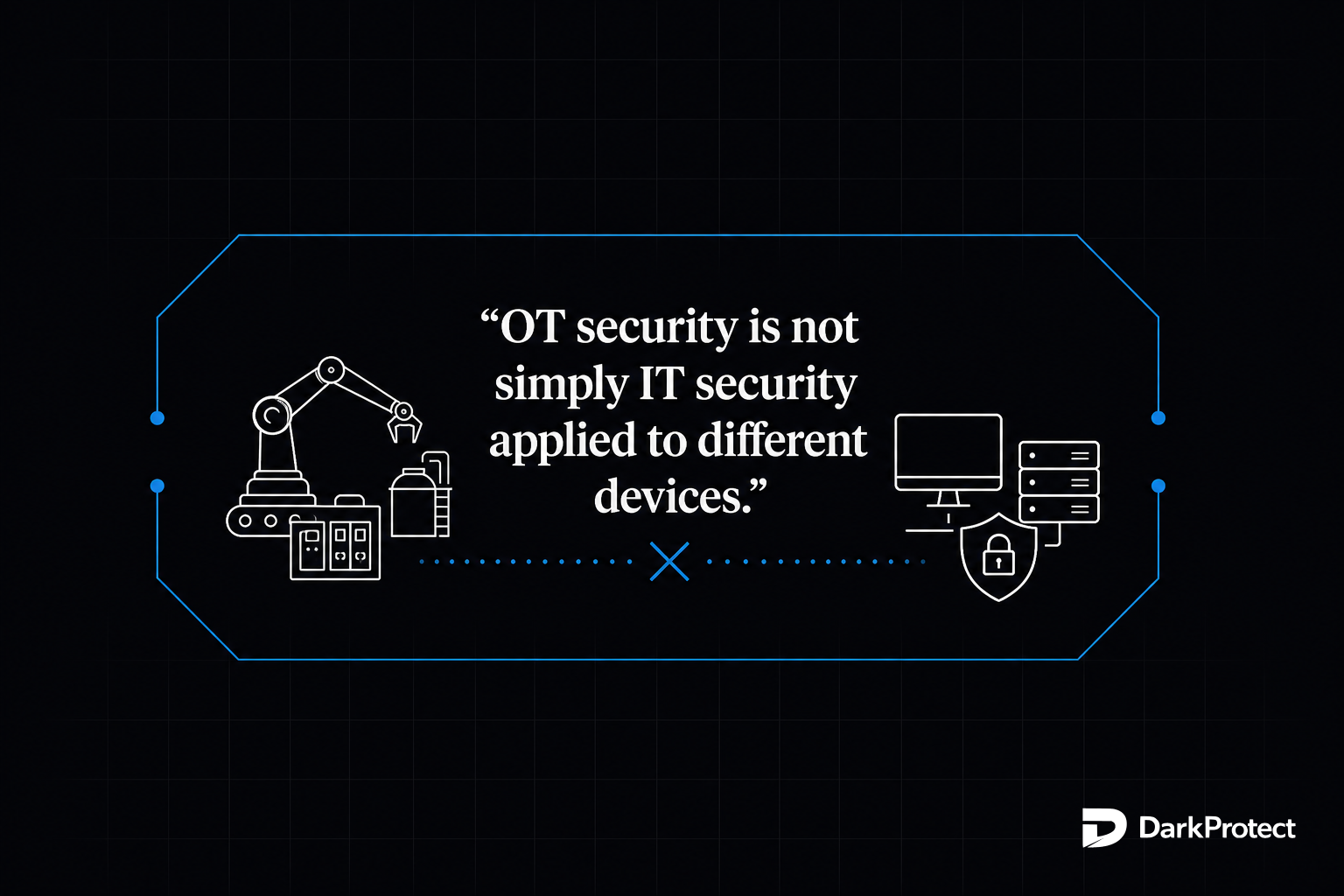
When people first approach Operational Technology (OT) security, it is tempting to apply the same principles used in traditional IT environments.
Firewalls.
Patching.
Endpoint protection.
Identity management.
Vulnerability management.
All of these still matter.
But OT security starts from a fundamentally different reality:
A cyber incident can affect the physical world.
OT systems monitor or control physical processes: industrial machinery, energy production, transportation systems, manufacturing lines, water treatment facilities, building automation systems and many other critical operations.
This changes the way cybersecurity risk must be approached.
In IT, data is often the primary concern. In OT, the process is.
Traditional information security is commonly structured around:
Confidentiality — Integrity — Availability
In an OT environment, priorities may look very different:
Safety — Availability — Integrity — Confidentiality
Stopping a production line, interrupting an energy distribution process or changing the behaviour of an industrial controller can have consequences far beyond the loss of information.
This is why simply extending the corporate IT security model into an industrial network is rarely enough.
OT environments have very different constraints
An IT team may consider patching a vulnerable server an obvious action.
In OT, that same decision may require stopping a production process, coordinating with an equipment vendor, testing compatibility with legacy software and potentially waiting for the next planned maintenance window.
Some industrial systems were designed to operate for 10, 20 or even 30 years.
Many were deployed when cybersecurity was not a design requirement.
And increasingly, those environments are now interconnected with corporate IT, cloud platforms, remote maintenance solutions and external suppliers.
The traditional separation between IT and OT is disappearing.
The attack surface is not.
So where do you start?
Fortunately, organizations do not need to invent an OT security methodology from scratch.
There are several established references that provide a strong foundation.
NIST SP 800-82 — Guide to Operational Technology Security
For anyone starting with OT security, NIST SP 800-82 Rev. 3 is probably one of the best entry points.
It explains OT architectures, threats, vulnerabilities and security controls while explicitly considering the performance, reliability and safety requirements that make OT environments different from conventional IT.
ISA/IEC 62443 — a key industrial cybersecurity reference
The ISA/IEC 62443 series is one of the key frameworks for securing industrial automation and control systems.
It addresses security across the lifecycle and across different actors, including asset owners, service providers, system integrators and product suppliers.
One particularly powerful concept is the use of Zones and Conduits.
Instead of viewing an industrial environment as one large trusted network, systems are grouped according to their security requirements and communications between them are explicitly controlled.
This moves OT architecture away from implicit trust and towards deliberate segmentation.
MITRE ATT&CK for ICS — understanding the attacker
Controls are only one side of cybersecurity.
Organizations also need to understand how attackers operate.
MITRE ATT&CK for ICS provides a dedicated knowledge base describing adversary techniques against industrial control environments.
It helps connect security architecture and controls to realistic attack scenarios.
CISA — turning principles into operational practices
CISA also provides extensive OT and industrial-control-system cybersecurity guidance.
Many of the recurring themes are remarkably consistent:
asset inventory, network segmentation, secure remote access, monitoring, incident response and tighter control over external connectivity.
These principles sound simple.
Implementing them consistently across a complex industrial environment is not.
And in Europe, OT security is increasingly a regulatory issue
OT security is also moving beyond engineering and becoming a governance and regulatory concern.
Under NIS2, many organizations in sectors where OT plays a central role — including energy, transport, water and certain manufacturing sectors — are now subject to strengthened cybersecurity risk-management requirements.
ENISA's NIS360 2024 report also highlights the varying dependence of critical sectors on OT and the importance of resilience across increasingly interconnected environments.
This means OT cybersecurity can no longer remain an isolated technical topic managed only by industrial engineering teams.
It now sits at the intersection of cybersecurity, risk management, asset management, supplier management, business continuity, safety and compliance — disciplines that used to live in separate silos and increasingly cannot.
A practical OT security program therefore starts with visibility
You cannot protect what you do not know exists.
Before deploying another security technology, organizations should be able to answer some relatively basic questions:
What OT assets do we have?
Which systems are critical to operations?
How are they connected?
Which suppliers have remote access?
Which systems cannot be patched?
What would happen if a critical component became unavailable?
What compensating controls exist?
And who owns the associated risk?
These questions are often more important than the choice of cybersecurity product.
OT security is ultimately about cyber risk meeting physical reality
That is perhaps the most important distinction.
In traditional IT security, we usually protect information and digital services.
In OT security, we may ultimately be protecting:
machines, production, infrastructure, people and physical processes.
The technologies may sometimes look similar.
The consequences are not.
And that is why OT security deserves its own architecture, governance and risk-management approach.
At DarkProtect, we help organizations connect cybersecurity, risk, assets, third parties and compliance into a single governance approach — including where IT and OT increasingly converge.

Cyber Resilience Act (CRA): What Changes with ETSI’s 17 Draft Standards in 2026
The CRA enters its operational phase with 17 ETSI draft standards. DarkProtect analyses timelines, SBOMs, supply chain security and product…
Read article
AI Epistemology: Different LLMs, Better Security Decisions
Different LLMs can challenge the same security problem from different perspectives, exposing blind spots and improving the final decision. The future…
Read article